
If you’ve been treating AI citation like a downstream effect of good SEO, the evidence says otherwise.
The signals that get a page ranked on Google and the signals that get a brand cited by ChatGPT, Perplexity, or AI Overviews overlap less than most people If you’ve been treating AI citation like a downstream effect of good SEO, the evidence says otherwise. The signals that get a page ranked on Google and the signals that get a brand cited by ChatGPT, Perplexity, or AI Overviews overlap less than most people assume, and in one specific place they point in opposite directions entirely: backlinks.
This piece covers the off-site side of AI citation specifically. If you want the technical prerequisites first, crawl access, JS rendering, schema, see our companion audit. This is what happens after a bot can actually reach your content.
Unlinked mentions beat backlinks, and it isn’t close
Ahrefs analysed 75,000 brands to find out which off-site signals actually predict AI Overview visibility. Unlinked brand mentions, plain text naming your brand with no hyperlink attached, correlated with AI visibility at 0.664. Traditional backlinks came in at 0.218. That’s roughly a three-to-one gap in favour of mentions with no link at all.
A follow-up Ahrefs analysis found YouTube brand mentions, specifically in video titles and parsed closed-caption transcripts, correlate even more strongly, at 0.737. Branded anchor text sits at 0.527, brand search volume at 0.392. Backlinks are the weakest signal on the list.
Why does an unlinked mention outperform a hyperlink? Traditional search ranks pages using link graphs, PageRank and its descendants. AI systems retrieving and generating answers work differently: they map entities in vector space based on semantic co-occurrence, how often your brand name appears near the right category keywords, product terms, and comparative language. A link with generic anchor text carries almost no semantic information. A paragraph of unlinked text describing what you do, in the right context, carries plenty. The model doesn’t need to click through to understand the association.
Separately, Seer Interactive ran 300,000 keywords across finance and SaaS, narrowed to 10,000 questions, through OpenAI’s GPT-4o API to see which brands got mentioned. They found a real correlation (~0.65) between ranking on Google’s page one and getting mentioned by the LLM, but backlink volume showed almost no relationship at all. The authors were explicit that correlation isn’t causation here, but the pattern is consistent with the Ahrefs data: your Google ranking might matter as a retrieval filter, but the backlinks that helped build that ranking are not what’s getting you cited once the LLM is deciding what to say.
Practitioner implication: stop measuring off-site success purely by link count. A client mentioned by name in ten unlinked trade articles is in a stronger position for AI citation than one with ten generic backlinks and no editorial mentions at all.
Earned media dominates. Owned content is a minority signal
A joint study by Muck Rack and Seer Interactive, analysing 25 million links cited across AI search engines, found that 82% to 84% of all AI citations trace back to earned media: press coverage, review sites, trade journals, Wikipedia, community platforms. Brand-owned content, the client’s own blog and product pages, accounted for only around 6%.
Stacker, an earned-media distribution company, ran a controlled comparison: identical content published on a brand’s own domain versus the same content distributed through third-party news outlets. The distributed version saw a 239% median lift in AI citation rate. In 64% of cases, AI models cited the third-party publisher’s version instead of the brand’s own site. We’re flagging this one honestly: Stacker sells earned-media distribution, so they have a commercial interest in this finding. The result is still a real, methodologically described study (87 stories, 30 brands, 2,600+ prompts across 8 AI platforms), just read it knowing who ran it and why.
Practitioner implication: a content calendar built entirely around the client’s own site is optimising for the smaller 15-18% of the citation pool. Digital PR, third-party syndication, and getting covered rather than just publishing is now core AI-visibility work, not a nice-to-have alongside it.
Content freshness matters, but the exact numbers need more scrutiny
Multiple 2026 studies point to AI systems penalising stale content more aggressively than traditional search ever did. One analysis found content citation probability decays roughly 40-60% over 12 months without updates, and that recently updated pages (within 30 days) make up a large majority of ChatGPT’s most-cited URLs.
We’re presenting this direction with slightly less confidence than the mentions and earned-media findings above. The specific decay percentages come from newer, less independently corroborated studies than the Ahrefs and Seer research. The direction, fresher content gets cited more, is consistent across sources; the precise multipliers should be treated as indicative rather than settled.
Practitioner implication: build a quarterly refresh cadence for any content a client is relying on for AI visibility, updating dates, data, and substance, not just swapping the year in the title. Cosmetic date changes without real content updates are increasingly detectable and don’t earn the same lift as genuine refreshes.
The platforms don’t behave the same way
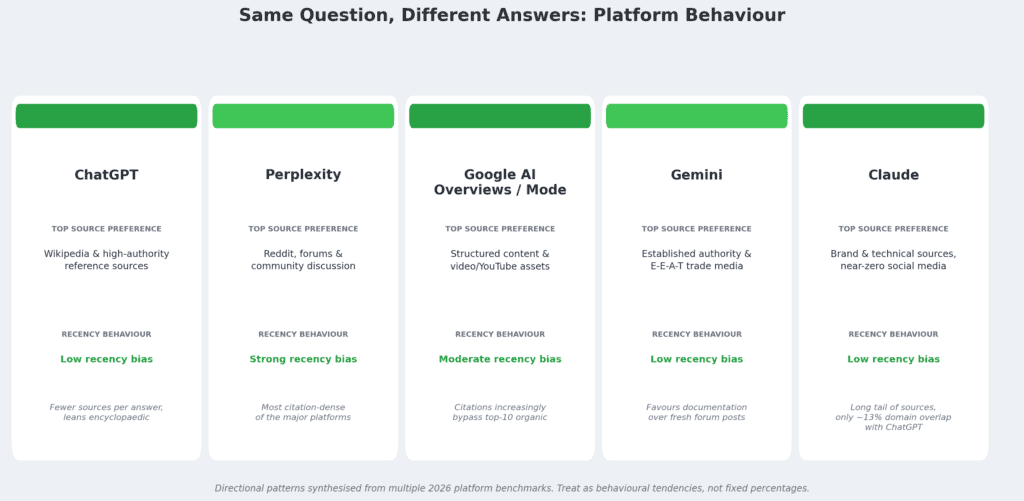
Treating “AI search” as one channel is a mistake. The evidence points to real behavioural differences:
ChatGPT leans heavily on encyclopaedic and high-authority reference sources, Wikipedia in particular, and tends to cite a smaller number of sources per answer than Perplexity.
Perplexity is the most citation-dense of the major platforms and shows a strong bias toward recent content and community discussion, including Reddit and forums.
Google AI Overviews and AI Mode increasingly cite pages that don’t appear anywhere in the traditional top-10 organic results, one analysis found citation overlap with organic rankings has fallen well below half in 2026, down sharply from where it sat when AI Overviews first launched.
Gemini shows a stronger lean toward established authority and E-E-A-T signals over raw recency compared to Perplexity’s real-time bias.
Claude is the outlier worth calling out specifically, because it cuts against the earned-media pattern this piece is otherwise built on. Multiple independent studies describe Claude citing a long tail of sources rather than a small dominant cluster (one analysis found the top 10 cited domains represented under 10% of total citations, with roughly a third of cited domains appearing only once), near-zero use of social media as a source, and low sensitivity to recency compared to Perplexity. More notably, brand-owned domains made up around 64% of Claude’s citations in one study, the opposite of the earned-media dominance seen elsewhere. Claude also shows the least citation overlap with ChatGPT of any pair measured, around 13% of domains in common. The practical read: Claude rewards well-structured, well-sourced, technically precise owned content more than the other platforms do, and won’t simply repeat a brand’s self-description without independent corroboration elsewhere.
Practitioner implication: a single piece of content won’t perform identically everywhere. If a client cares specifically about Perplexity visibility, community presence and freshness matter more. If they care about ChatGPT, reference-grade third-party authority matters more. If Claude visibility matters to a client, and it’s increasingly relevant given Claude’s enterprise reach, don’t neglect the client’s own site the way the earned-media data might suggest elsewhere; invest in making owned content read like a primary, well-sourced reference rather than marketing copy.
What we’re not including, and why
A few widely-circulated statistics didn’t make it into this piece because we couldn’t verify them to our standard, including a specific “citation source index” and a benchmark attributed to at least one vendor whose underlying data and methodology are not public. Where a stat is real but self-reported by a company selling the exact service the stat justifies (Stacker being the clearest example here), we’ve said so directly rather than presenting it as neutral.
The practical shift
If a client’s AI visibility strategy is still just “publish more on our own site and build some links,” the evidence here says that’s optimising for a shrinking minority of the citation pool. The larger, better-evidenced lever is earned presence: getting named, in context, across third-party sources the client doesn’t control, and keeping the content that does exist genuinely current rather than cosmetically dated.
Sources
- Ahrefs, “AI Overview Brand Correlation” study, 75,000 brands analysed. https://ahrefs.com/blog/ai-overview-brand-correlation/
- Seer Interactive, “What Drives Brand Mentions in AI Answers?” (Christina Blake, Nick Haigler), 300,000 keywords / 10,000 prompts via GPT-4o API. https://www.seerinteractive.com/insights/what-drives-brand-mentions-in-ai-answers
- Muck Rack, “What Is AI Reading?” (Generative Pulse), May 2026 edition, 25 million+ links analysed across ChatGPT, Claude, and Gemini. https://muckrack.com/blog/what-is-ai-reading-may-2026
- Stacker & Scrunch, earned media distribution study, 87 stories / 30 brands / 2,600+ prompts across 8 AI platforms, March 2026. https://www.globenewswire.com/news-release/2026/03/16/3256365/0/en/New-Stacker-Research-Earned-Media-Distribution-Triples-AI-Search-Visibility-Delivers-239-Median-Lift-in-Brand-Citations.html, note: Stacker is a commercial earned-media distribution vendor with a direct interest in this finding.
- Aggarwal, Murahari, Rajpurohit, Kalyan, Narasimhan, Deshpande, “GEO: Generative Engine Optimization,” Princeton University / Georgia Tech / Allen Institute for AI, ACM KDD 2024. https://arxiv.org/abs/2311.09735, note: benchmark run on GPT-3.5-turbo in a synthetic 2023/24 test rig; treat exact percentages as directional rather than a live current measurement.
- Otterly.ai, Claude AI citation behaviour study. https://otterly.ai/blog/claude-ai-citation-study/
- Media Copilot, reporting on Muck Rack’s Claude-specific journalism citation data. https://mediacopilot.ai/claude-cites-journalism-less-muckrack-study/
Content-freshness figures in this piece (the 12-month decay range and related recency statistics) are drawn from newer, less independently corroborated 2026 vendor studies. We’re not listing them here with the same confidence as the sources above; the directional finding, fresher content is favoured, is well supported, but we’d want to verify the specific studies further before citing them by name.
